Discover the hidden historical gems of Belarus through the ruins of its once-thriving water mills. From the early 19th century to the post-war era, these abandoned structures tell the story of the country’s industrial past. Journey through picturesque villages and explore the remnants of these mills, which stand as silent witnesses to a bygone era. Whether you’re an avid history enthusiast or simply love exploring off-the-beaten-path locations, this guide takes you through some of Belarus’s most fascinating and neglected landmarks.
The Ruins of the Water Mill at Kamennoe-Krivoe
If you travel along the R26 road from Tolochin to Vishov, you can spot the abandoned water mill near Drutsk along the way. The ruins belong to the village of Kamennoe-Krivoe in the Tolochinsky district.

The mill building is made of red brick and is three stories high, following a typical design for its time. According to the “Historical Heritage” plaque, it was built at the end of the 19th century. It is possible that the mill’s construction is linked to the Gordyalkovsky family, who owned a manor in Drutsk. More recently, the first floor was sealed off, and efforts were made to sell the building at auction, though these attempts have so far been unsuccessful.
The Ruins of the Water Mill in Zelva
One of the attractions in the urban village of Zelva is the abandoned water mill. Today, this brick building stands in a neglected condition, but in the late 19th and early 20th centuries, it was a highly functional industrial facility. Originally, the mill was four stories tall. On the top floor, there were inscriptions with construction dates, with locals recalling the year 1884. A historical photograph from 1941 shows how the Zelva mill looked at that time—its architecture is quite similar, although it had an additional floor.

After World War II, the mill lay in ruins for a long time before being rebuilt and used until the early 1990s. Since the 2000s, the building’s condition has deteriorated. Currently, a banner on the wall indicates it is for sale—perhaps there will be a buyer willing to restore this historic structure.

The mill ruins are located on the outskirts of Zelva, next to the Zelvyanka River. To reach the site, continue down September 17th Street to its end.
The Ancient Water Mill in Vidzy
One of the smaller yet interesting sights in the Vidzy urban village is the abandoned water mill, located near the Church of the Nativity of the Virgin Mary. The mill is a brick structure with a high basement and an attic on one side. On the other side, there is a one-story building with an added wooden floor.

Some sources suggest the mill was built in 1930, but this is likely incorrect. Old photographs from 1914 show that Vidzy was already densely developed, and there was little space for new construction. It is more likely that the mill was expanded or rebuilt in the 1930s after being damaged during World War I. The mill’s owner, Jewish businessman Hershku Gusman, funded the rebuild and expanded its functions, transforming it into a multifunctional factory.

After the war, the mill building was used for various economic and administrative purposes. Efforts to reconstruct it in the 1990s were unsuccessful, and the mill now stands half-abandoned in the heart of Vidzy.
The Ruins of the Water Mill in Petrovshchina
Not far from the village of Gorodok in the Molodechno district, you can find the ruins of a water mill, often referred to as “Kalinowski’s Mill.” The building, though heavily neglected, is situated in a picturesque location on the banks of the Western Berezina River. It was likely built in the second half of the 19th century, around 1875, when these lands belonged to the Korsakov family, who had an estate in Petrovshchina.

The mill is constructed from large rubble stone and brick, covering an area of about 100 square meters. Interestingly, it was still in use until the late 1970s. Several years ago, the mill was put up for sale (it is not considered a historical heritage site), but no buyer was found, and during this time, the roof collapsed.
The Ruins of the Water Mill in Treskovshchina
Continuing our tour of Belarus’s picturesque sites, head west from Minsk, and after 40 minutes and 40 kilometers, you’ll arrive at the village of Treskovshchina. Here, the ruins of a 19th-century water mill have been partially preserved. From the center of the village, turn right and head down to the outskirts near a small reservoir, where the mill is located.

It’s evident that the site has been abandoned for a long time, yet it holds a certain aesthetic charm. The surrounding forest and river enhance the natural beauty of the area, making it a fascinating place to visit. Additionally, in the village of Treskovshchina, you’ll find an abandoned school, should you be interested in exploring such places.
Polonechka – The Ruins of a Water Mill from 1819
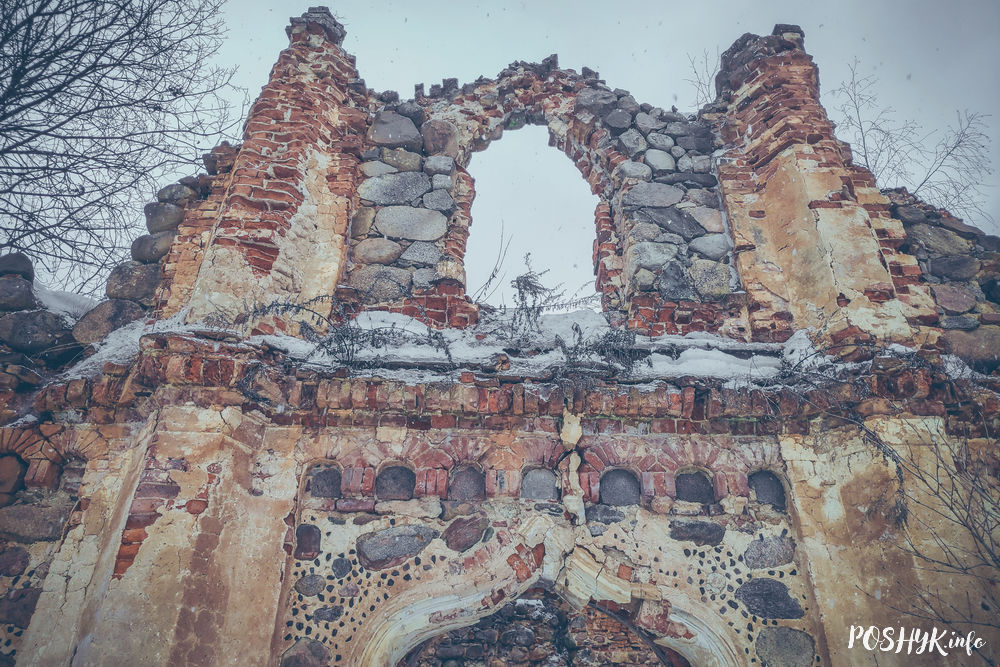
The small village of Polonechka, located just a few kilometers from the M1 highway at the intersection of two roads—H277 and H295—leads to Ishkold (where one of Belarus’s oldest churches is located), is home to an abandoned mill. The water mill was built at the start of the 19th century. A stone at the foundation still bears the inscription “1819,” marking the year construction began.
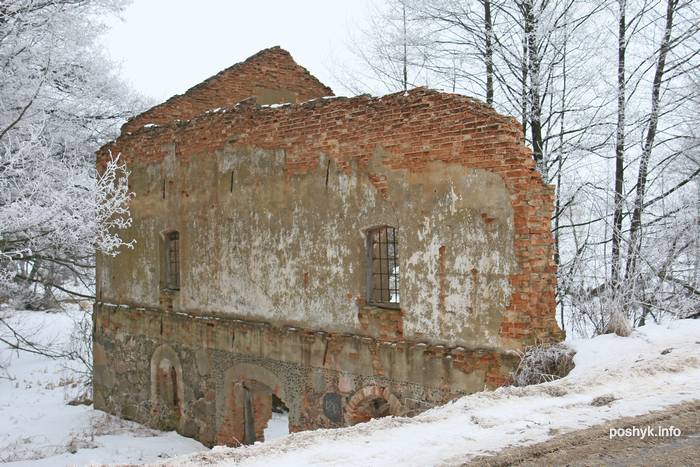
Only two walls remain of the mill itself, and some of the window openings still have bars. In the village, you can also find the Church of St. George and the Palace of the Radziwills. Similar water mills can be found across the country, often restored near major cities.
The Abandoned Water Mill in the Village of Uzla
What was once a water mill is located on the banks of a picturesque river in the Minsk region, near the village of Uzla. The village lies close to the P28 highway, and if you head toward Naroch, you’ll spot the ruins on the right side of the road. Today, only the side walls of the mill remain, as the roof has collapsed, and the entire area is overgrown with weeds.

Not far from the mill, you’ll find an abandoned club. As you explore the village, you’ll likely encounter many other derelict buildings.