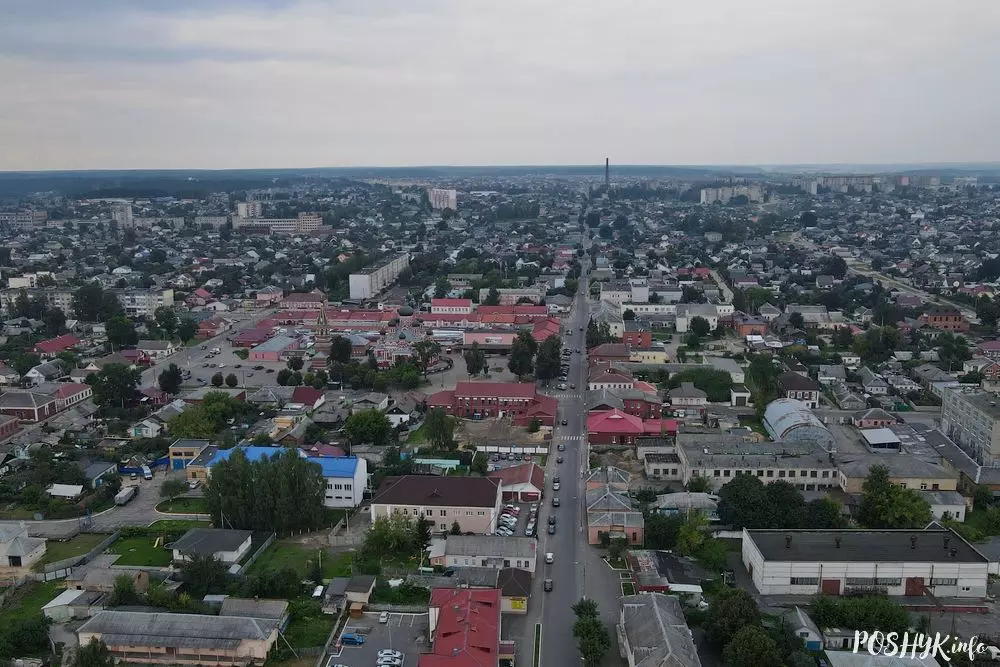
Borisov is divided into two parts by the Berezina River. One part is modern, while the other is older and more historically significant, housing many of the city’s attractions. Besides the Resurrection Cathedral and the Church of the Nativity of the Virgin Mary, the city is home to shopping arcades, several synagogues, late 19th- and early 20th-century buildings, and a fascinating former women’s gymnasium. Discover the Resurrection Cathedral, Shukhov Water Tower, Borisov Castle ruins, and other historical landmarks in Borisov, Belarus. Explore the city’s rich architectural heritage, including churches, synagogues, and 19th-century buildings.
Resurrection Cathedral in Borisov
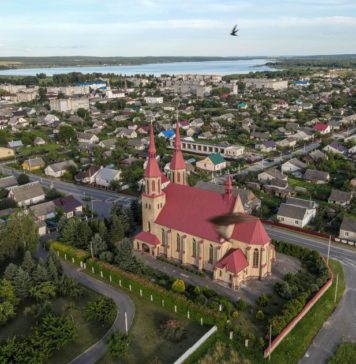
In the historical center of Old Borisov stands one of the city’s main attractions: Resurrection Cathedral. The Orthodox church was built in 1874 and is located on the market square. Architecturally, the cathedral clearly exhibits the pseudo-Russian style. It can be safely considered one of the most prominent examples of this type of architecture in Belarus.

Before the cathedral was built, a wooden church stood on the site, constructed in the early 17th century, but it was destroyed by fire. Following this event, the St. Petersburg architect Pyotr Merkulov developed a design for the new Orthodox church, which stands today. Construction of the cathedral began in 1871 and lasted for three years. It was officially consecrated in October 1874.

In 1907, the bell tower was completed according to the design of architect Viktor Struev. The bell tower complemented the cathedral’s overall appearance, blending seamlessly with the existing structure. During World War II, the cathedral in Borisov was undamaged and was preserved. A monument to the founder of Borisov, Boris Vseslavich, stands in the market square.

While walking through the old part of Borisov, you can easily find another city landmark: the Church of the Virgin Mary.
Address of the Cathedral: Borisov, Lopatina Street, 34.
Church of the Nativity of the Virgin Mary in Borisov
This classical-style temple was built in the early 19th century in the central part of Borisov. Construction began in 1806 on the site of an earlier wooden church, and the work dragged on until 1823. The church was later rebuilt several times.

Like many other Catholic churches, it was closed in 1863 by order of the Russian authorities. The Church of the Virgin Mary reopened at the end of the 19th century and continued to hold services until 1937, when it was closed again by decree of the Soviet government.

For 50 years, the church was not used for its intended purpose. At the end of the 20th century, services resumed, and the building began to be restored. The restoration work was completed in 2016–2017, and today the church is a beautiful landmark on the city’s central street.

Address of the Church: Borisov, 3rd International Street, 28.
Borisov: Shopping Arcades, Synagogue, and Historic Buildings
Borisov is divided into two parts by the Berezina River. One part is modern, while the other is older and more historically significant, housing many of the city’s attractions. Besides the Resurrection Cathedral and the Church of the Nativity of the Virgin Mary, the city is home to shopping arcades, several synagogues, late 19th- and early 20th-century buildings, and a fascinating former women’s gymnasium. Today’s International Street was once the site of a synagogue courtyard, with the Great Synagogue being the dominant feature. The building, constructed in 1912, likely replaced an earlier wooden synagogue. In the mid-20th century, the structure was thoroughly rebuilt, changing its original architecture.

The synagogue was initially a single-story building with high arched windows, a triangular pediment, and decorative elements. Across the street (Komsomolskaya 78) stood another synagogue, which has also undergone extensive renovations, leaving it with few original features.
Nearby, pay attention to the shopping arcades, which form an entire complex dating back to 1892. These historic buildings are combined with modern counterparts, their neoclassical architecture standing out.

The entire arcade complex consists of four rectangular buildings, originally comprising 112 structures. Some parts have been rebuilt and repurposed over time, but the general appearance has been preserved. It’s nice to see that the original decor, including pediments, projections, cornices, and even two pinnacles, remains visible.

While walking through the arcades, you’ll notice a brick building with arched windows—a part of residential development from the early 20th century. Further down the street are several other similar buildings, including the former Jewish school “Talmud Torah,” a pedagogical school, and another synagogue, “Hevre Telim.”

Shukhov Water Tower in Borisov
Borisov is home to a unique monument to both architecture and 20th-century industrial progress: the Shukhov Water Tower. Erected in 1927 according to the design of the legendary Soviet engineer and architect Vladimir Shukhov, it was one of the first structures to utilize steel mesh shells in construction. Additionally, Shukhov pioneered the use of the hyperboloid structure, which is exemplified in this water tower. The hyperboloid design of the tower is still impressive to modern architects, as there are few examples of such early 20th-century structures in Belarus.

The water tower is located in the private sector of Borisov, on Engels Street. Unfortunately, its condition is poor, and the surrounding area, enclosed by a wooden fence, is littered with garbage. The entrance gate is open, making it accessible but also a potential safety hazard.

The tower stopped being used for its original purpose after World War II. Plans for its demolition were eventually abandoned, and the building gradually fell into disrepair. Around 2010, the Borisov Water Tower was designated as a “Historical Heritage” site, but this designation has not yet led to significant preservation efforts.
Borisov Castle or Prison Castle
The exact date of construction of Borisov Castle is uncertain. Historians suggest it was built between the late 12th and mid-14th centuries. Initially made of wood, it was a well-fortified structure. The castle withstood a siege by Russian troops in 1514, but during the Russian-Polish War of 1655, it fell and was completely destroyed. Despite this, the castle’s history did not end there, as it was rebuilt and destroyed several more times.

The ruins that remain today are part of the later Borisov prison castle, built on the castle site toward the end of the 19th century.

The prison was surrounded by a stone wall, and to the west lay the Berezina River. A defensive moat also partially remains, providing a glimpse into the heritage of the original fortress.

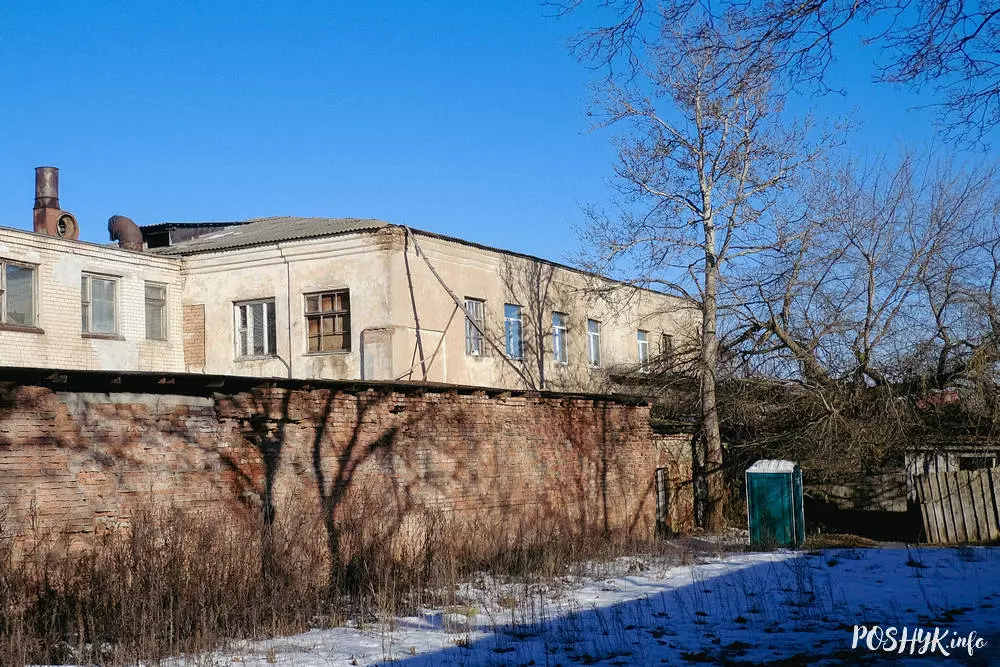
In the 1920s, the prison was severely damaged, but it remained in use until World War II. After the war, little remained of Borisov Castle. In the 1970s and 80s, the moat was filled in, the buildings fell into ruin, and the walls were dismantled for bricks. Why is the Borisov Castle so little known? First, it is difficult to reach. The castle site is surrounded by residential buildings, with no signs or accessible information. Second, only ruins remain, which may not appeal to everyone.

How to get there: Arriving in Borisov, approach the castle via Gogol Street, not Rechnaya Lane. This will save you the trouble of walking around houses in search of a passage.