This collection takes you on a journey through the forgotten ruins of historical churches scattered across rural Belarus. From the decaying walls of 19th-century Orthodox temples to the faded remnants of Uniate and Catholic churches, these stories uncover the rich yet often overlooked architectural heritage of the region. Through these ruins, we explore the passing of time, the impact of war and Soviet-era policies, and the efforts of local communities to preserve their history. Each church tells a unique story of devotion, loss, and resilience.
The Ruins of the Church in the Agricultural Town of Sidorovichi
The village of Sidorovichi, located in the Mogilev region, has been known since the mid-16th century. Today, it is a small agricultural town on the E95 highway, which connects Mogilev and Gomel. Among the sights in Sidorovichi, I would like to highlight the atmospheric ruins of the church. There is very little information about this temple. Historical records from 1848 mention a wooden church in the village of Sidorovichi. Therefore, the stone church was probably built toward the end of the 19th century. The church is constructed of brick in the shape of an octahedron or octagon. Equally fascinating is the vaulted ceiling, which resembles petals covering the dome.
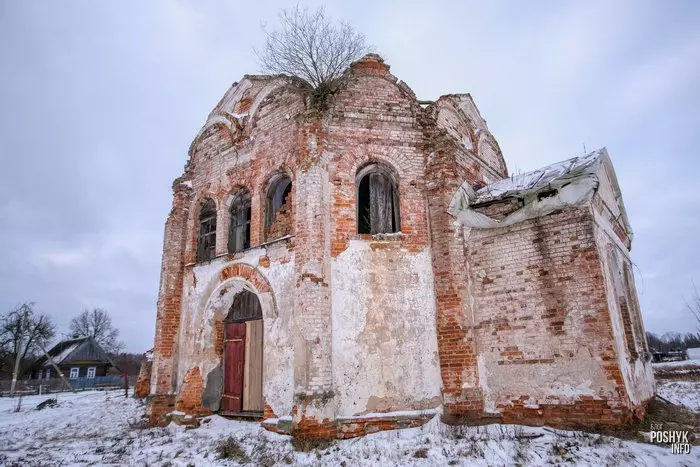
Despite the rather dilapidated state of the building, some of the paintings and decorative elements have been partially preserved inside. A few years ago, the church was mothballed: all openings were sealed, and the dome and walls were protected from further deterioration. At the entrance to the agro-town, you can also see the restored postal station, which is over 150 years old. Similar stations were built throughout the country according to a standard design.
Prechistenskaya Church – Ruins in the Village of Krugloye
There are many interesting places in the Pruzhany district, Brest region. One of them is the former Kraszewski estate, “Old Kuplin.” The estate itself has not survived to this day, but the Prechistenskaya Church remains, albeit in ruins. Finding the ruins of this temple is a real quest, with the nearest settlement being the village of Krugloye. In 1834, a family tomb for the Kraszewski family was built on this site. After the 1863 uprising, a church was likely organized here, with some alterations to the original building.
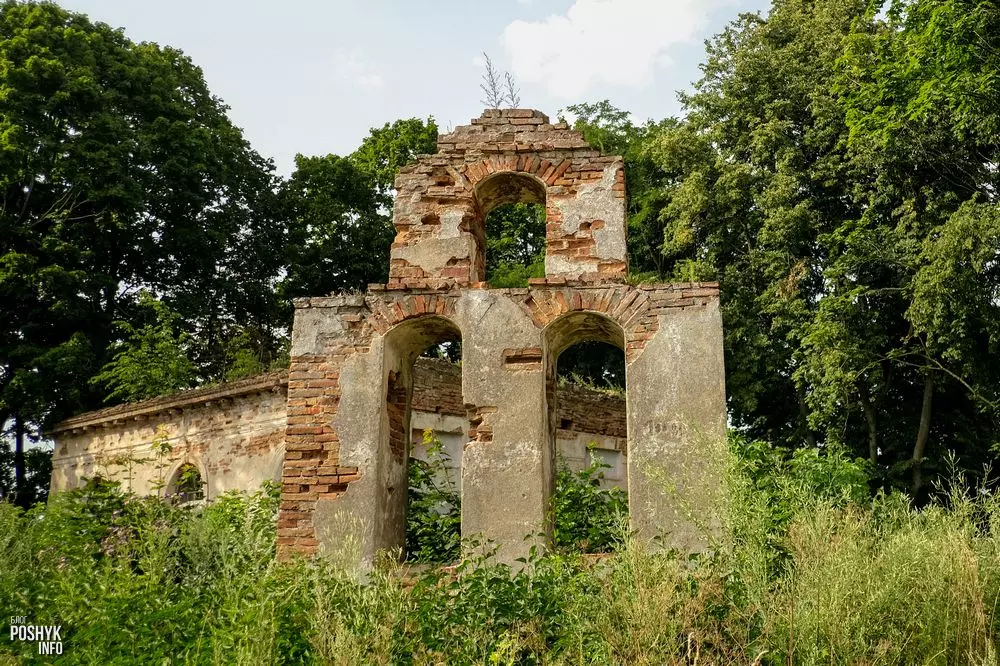
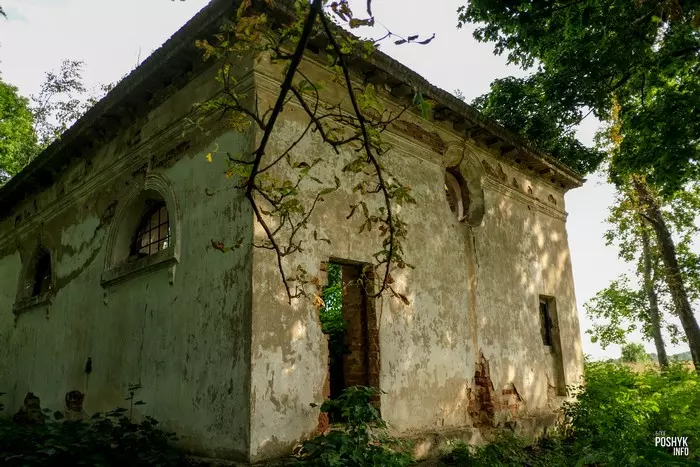
The architecture of this temple is in the Empire style. The building is rectangular, small in size (about 15 x 6 meters). In front of the entrance to the temple stood an arched bell tower.
[adinserter block=”1″]Ruins of the Trinity Church in Mostoviki
In the Myadel district, 15 km from Budslav, there is a small village called Mostoviki. Not far from it, on the way to Old Gabs, are the preserved ruins of the Trinity Church. The temple was built at the end of the 19th century and is an example of retrospective Russian architecture. The building was constructed from red brick. Unfortunately, the village of Mostoviki was almost completely burned down by the Germans during World War II in 1943.

After the end of hostilities, local residents rebuilt the village from scratch, including restoring the temple. However, during the religious persecution and the promotion of atheism by the Soviet authorities, the Trinity Church was destroyed. Since 1964, it has remained in ruins. The outlines of window openings and entrances have been preserved. One way or another, the brick walls, which have lost much of their original strength, are gradually deteriorating and fading into history.
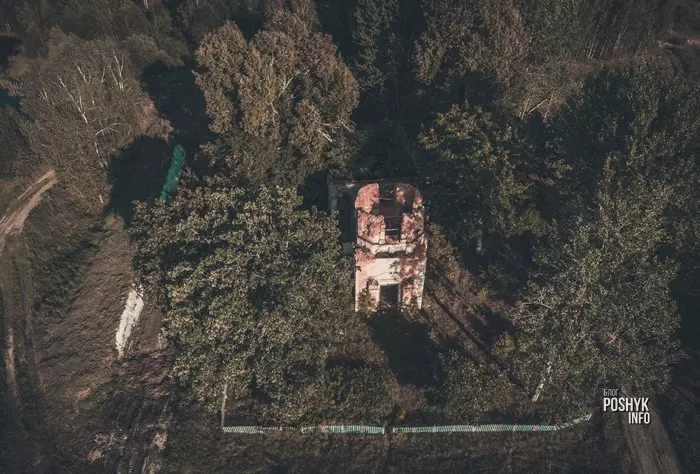
On the temple grounds, the burial sites of saints and abbots have been preserved. A priest tends to them and maintains order at the Trinity Church, if possible, along with the Church of Saint Nicholas, located in the village of Old Gaby. Given the current state of the Trinity Church ruins, it is unlikely that restoration is planned. Based on the appearance of the ruins, it may be possible to recreate the former shape of the temple.
Krasnaya Sloboda – The Ruins of the Church on the M5 Highway
There are several large cities along the section of the M5 highway running from Minsk to Gomel. Be sure to visit the historical Bobruisk and then head to Zhilichi and Red Beach. In this area, you can also find the ruins of a small church. On the outskirts of the village of Krasnaya Sloboda, a temple has been partially preserved, though little is known about it.
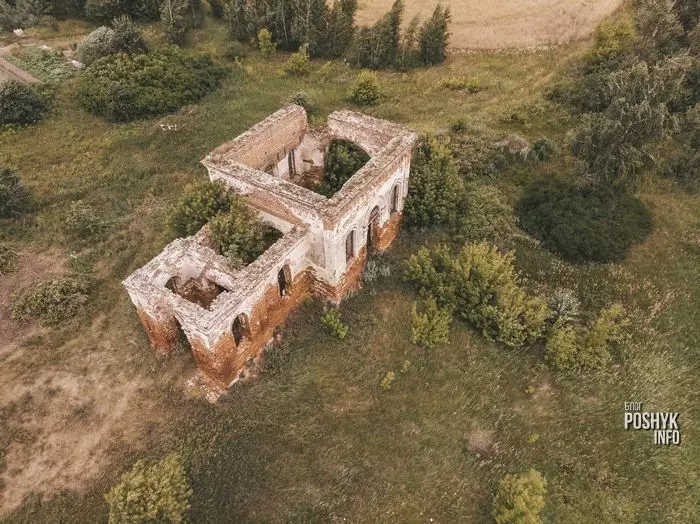
The church is typical in design. Similar temples can be found throughout Belarus. For example, a similar church exists in the village of Mosar, albeit in a similar state of decay. The building dates from the 19th century. Classic style of architecture. The church has been abandoned since Soviet times. Probably just after the war. Today only the walls remain of the temple.
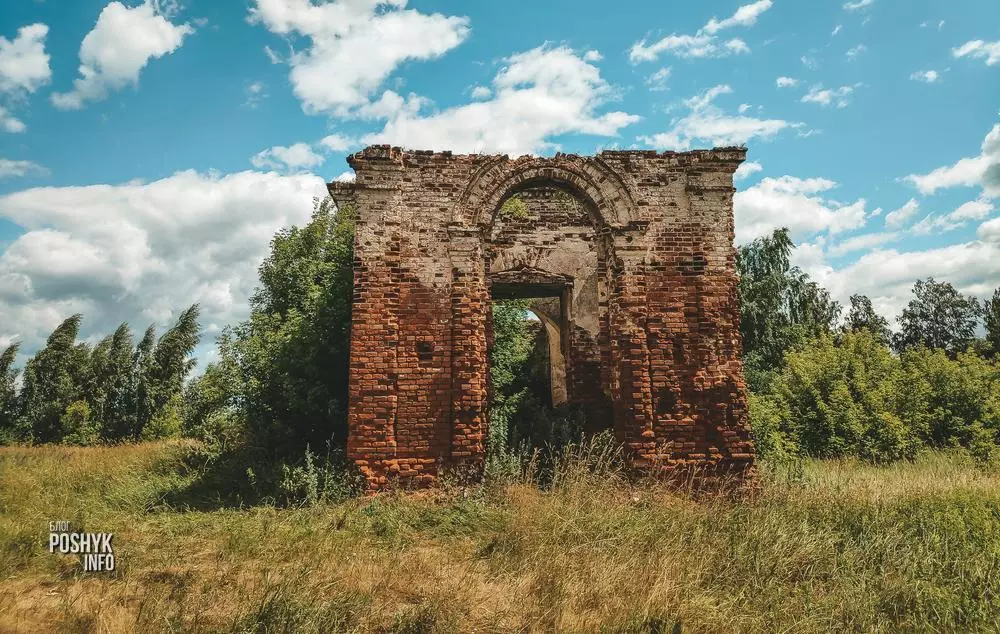
The Ruins of the Church of St. George in the Village of Komsomolskaya
The village of Komsomolskaya, located in the Kopyl region, was part of Pukovo (nowadays Sunai) until 1964. The Church of St. George, whose ruins can be seen today, was built on the site of an earlier Catholic church. This church, constructed in 1858, replaced a wooden predecessor. The building is now in ruins, but the site is fenced, free of debris, and well-maintained.

In the 1930s, a farm was built near the church, which still exists and is actively functioning. St. George’s Church was funded by the Iodko family, whose estate is partially preserved in the village of Sunai. The estate is located just a few kilometers away and once belonged to Pukovo. The church in Komsomolskaya was closed in the 1930s, during the period of the BSSR. For many years, the building was used as a warehouse, and over time, it fell into disrepair and was abandoned.
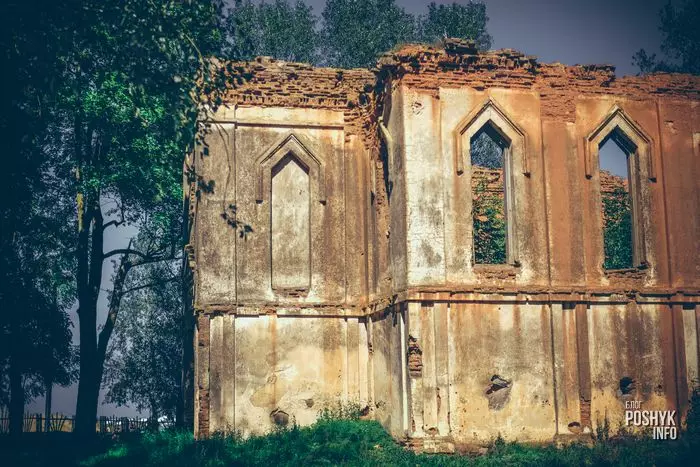
From the P91 highway (section Zamosc – Staritsa), immediately after the village of Sunai, a turnoff leads to the ruins of the Komsomolskaya Church.
[adinserter block=”1″]Abandoned Church of Saints Peter and Paul in the Village of Starinki
The Church of Saints Peter and Paul was built in the 1830s on the outskirts of the village, commissioned by Alexander Lensky, who owned the area at that time. Initially, the now-abandoned church in Starinki was constructed as a Roman Catholic church and was a rectangular building in the style of late classicism. In 1836, the church was completed, but almost immediately it was handed over to the Uniate Church. In 1839, it became an Orthodox church.
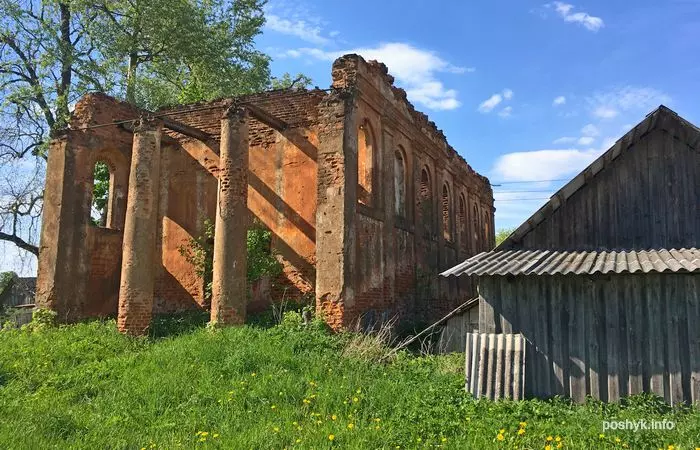
The church in Starinki was destroyed during the Great Patriotic War and has not been restored or reconstructed. At present, the temple is in a dilapidated state. Finding the ruins of the church is not difficult, as they are located on the way to the Dudutki museum complex.
Ruins of the Church of St. Peter and Paul in the Village of Vyshov
Not far from the M3 highway, 20 kilometers from Mogilev, there is a small agro-town called Vyshov. In this seemingly unremarkable place stand the ruins of the old Church of Saints Peter and Paul. Despite the fact that the building is almost completely destroyed, local residents have built a small altar and continue to maintain the walls of the former temple.
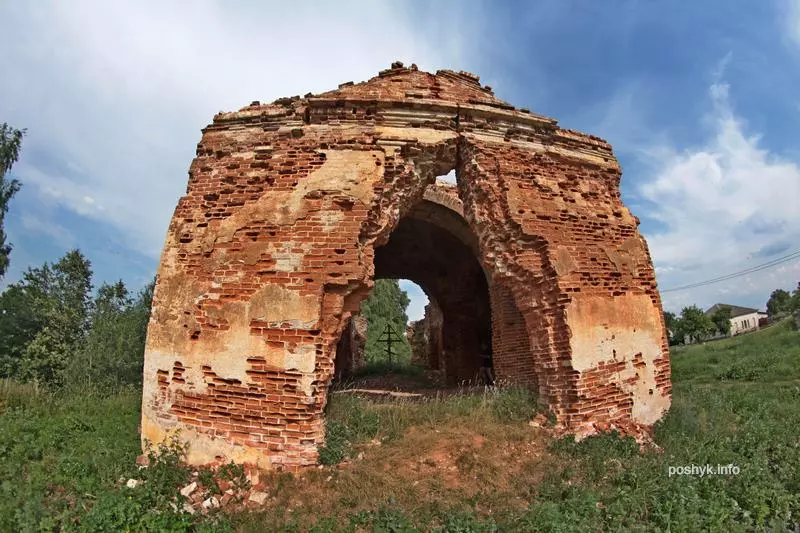
The church was built in the 19th century in a village originally called Nezhkovo (the name was later changed to Vyshov). This was a significant event for the residents of the Belynichi district—the Church of St. Peter and Paul became the second stone Orthodox church in the area. For more than 200 years, divine services and church ceremonies took place within its walls. After the construction of the Pokrovsky Church at the end of the 19th century and the opening of a parish in the neighboring village of Kryuki, the Church of Saints Peter and Paul ceased to be a parish church. It regained its status just a few decades later, when Father Sivakov returned to serve in this church. Unfortunately, during the Soviet period in the 1930s, the church was destroyed as part of the widespread policy of eliminating religious life. In recent years, a decision was made to build a new church on the same site, which bears the same name—Church of Saints Peter and Paul.
Ruins of a Church in the Village of Pochaevichi
Pochaevichi is one of the many villages in the Vitebsk region that has the status of an agro-town. Approximately 250 inhabitants live here. The P62 motorway passes through the village, running from Chashnikov almost all the way to Bobruisk. What interesting things can be seen here? Perhaps the main attraction of Pochaevichi is the picturesque ruins of a church. As is often the case with such places, there is no verified information about the history of this temple.
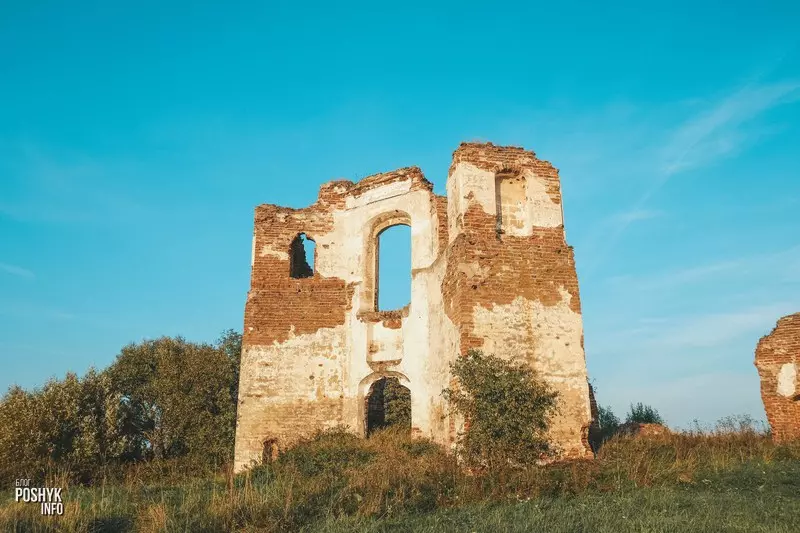
Several sources suggest that the church was probably built in the second half of the 17th century. Initially, the temple was Uniate, and after 1860, it became Orthodox. It was completely closed in the 1930s, and after that, it began to deteriorate rapidly. According to a Vitebsk newspaper, local residents also contributed to the destruction. When the church was left without a priest, they quickly began to dismantle it for bricks. Sadly, the “extracted” material was difficult to use, as the bricks had crumbled badly. Moreover, a brick factory was located just 10 kilometers away. In short, it was a sad situation.
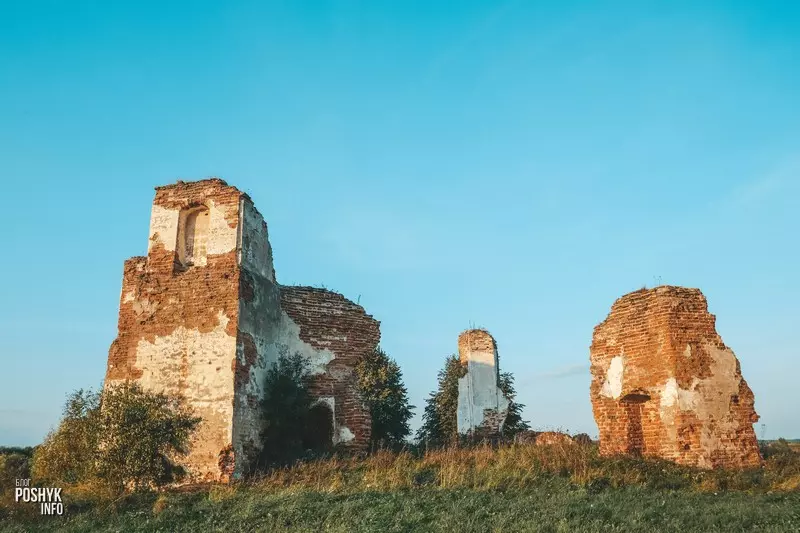
Approaching the ruins is rather difficult. There is no trodden path, so you will need to ask for permission to pass through someone’s property, or simply admire the vanishing history of Pochaevichi from afar.
Ruins of a 19th Century Church in the Village of Koltovo
In the Mogilev region, there is a small village called Koltovo, where you can see the ruins of an old church. There is very little information about this temple. It is known that the church was built in the second half of the 19th century, probably on the site of a wooden predecessor. The Koltovo Church is made of red brick and plastered. Decorative arches have been preserved on the main facade, and the corners of the temple are adorned with false columns. The architecture exhibits features of the Byzantine style.

The entrances were walled up a few years ago. Since there are almost no local residents in the area, one wonders who carried out these works. By the way, there is no “Historical Heritage” sign on the church. Inside the abandoned church, trees are already growing freely, and they will soon reach the height of the walls.
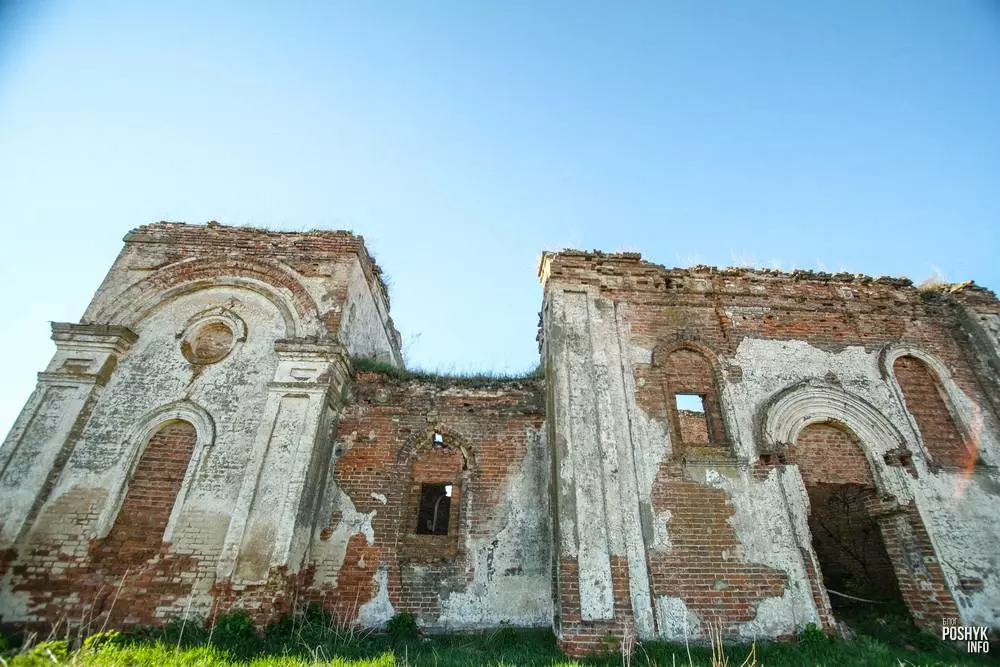
Koltovo is located 13 kilometers from the city of Mstislavl. To reach the ruins, turn towards the village of Pirogovo, from where it is just a few more minutes of travel. The abandoned church is located right next to the road, so it is hard to miss.
Abandoned Sretenskaya Church in the Village of Mosar
In the small village of Mosar (sometimes spelled Mosor), the partially preserved Sretenskaya Church stands in an abandoned state. The temple is located on the outskirts of the local arable fields, at the fork to the left of the reservoir. There are many similar ruins in the Vitebsk region, such as in Gubino, Settlement, Martinovo, Candle, Slobodka, and many others. *Do not confuse this village with another famous place in the Vitebsk region—Mosar, where the Church of St. Anne is located.
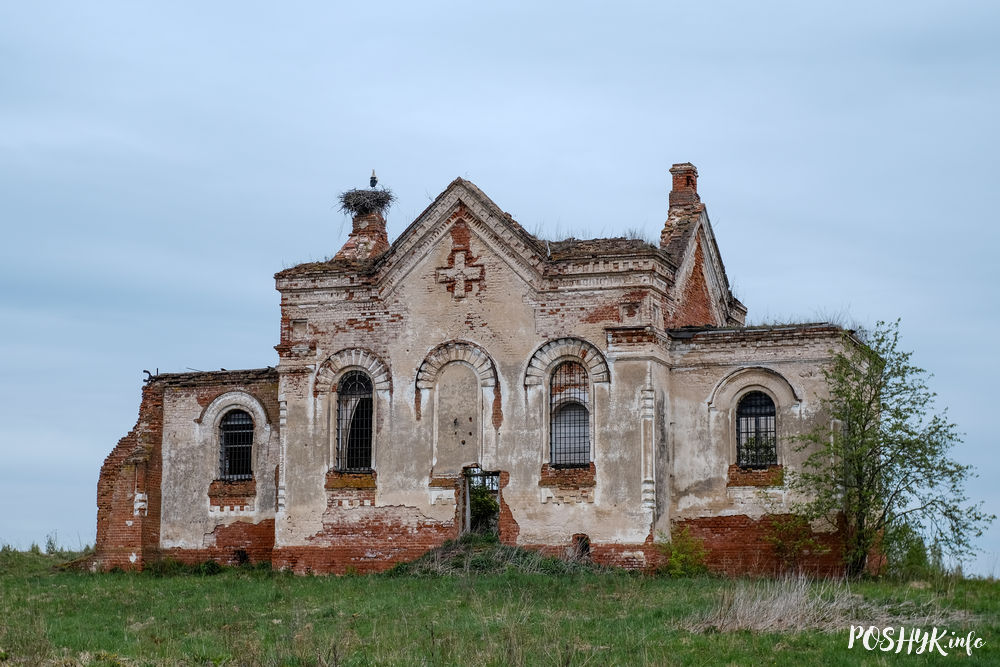
The temple was built in 1860 and was abandoned in the early 20th century, around 1914-17. Most likely, it remained empty and unused after that time. The Church of the Presentation of the Lord in Mosar is made of stone, and the architectural style is difficult to determine, though it is likely to be pseudo-Russian. There was probably a bell tower, but nothing of it has survived.
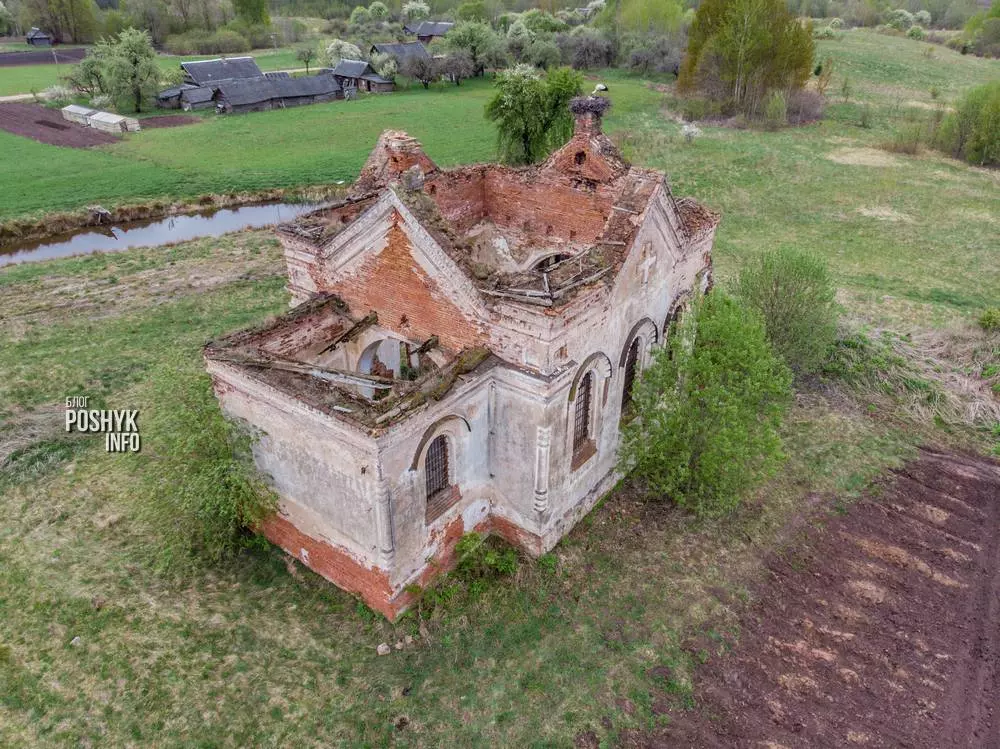
Getting to the abandoned church is not easy. The village of Mosar is located a few kilometers from the Lepel–Polotsk highway, just before the village of Ushachi. The reference point is Lake Masarskoe; keep left at the fork.